
Definition der Liebe (Liedermacher)
Liedermacher - contradiction evolves from Tango tension and emotional complexity of Klezmer into reflective Jazz wanderings, polished Waltz elegance, and vulnerable personal confessions.
Einführung
Hier ist eine poetische Version über die gegenseitige Verstrickung von Liebenden, die den Begriff der romantischen Liebe und deren Verlangen nach Besitz mit dem Ideal der Freiheit in einer Beziehung zu verbinden versucht.
English Translation
Here’s a poetic version about the mutual entanglement of lovers trying to combine the notion of romantic love and it's desire for possession with the ideal of freedom in a relationship.
Deutsches Gedicht / English Poem
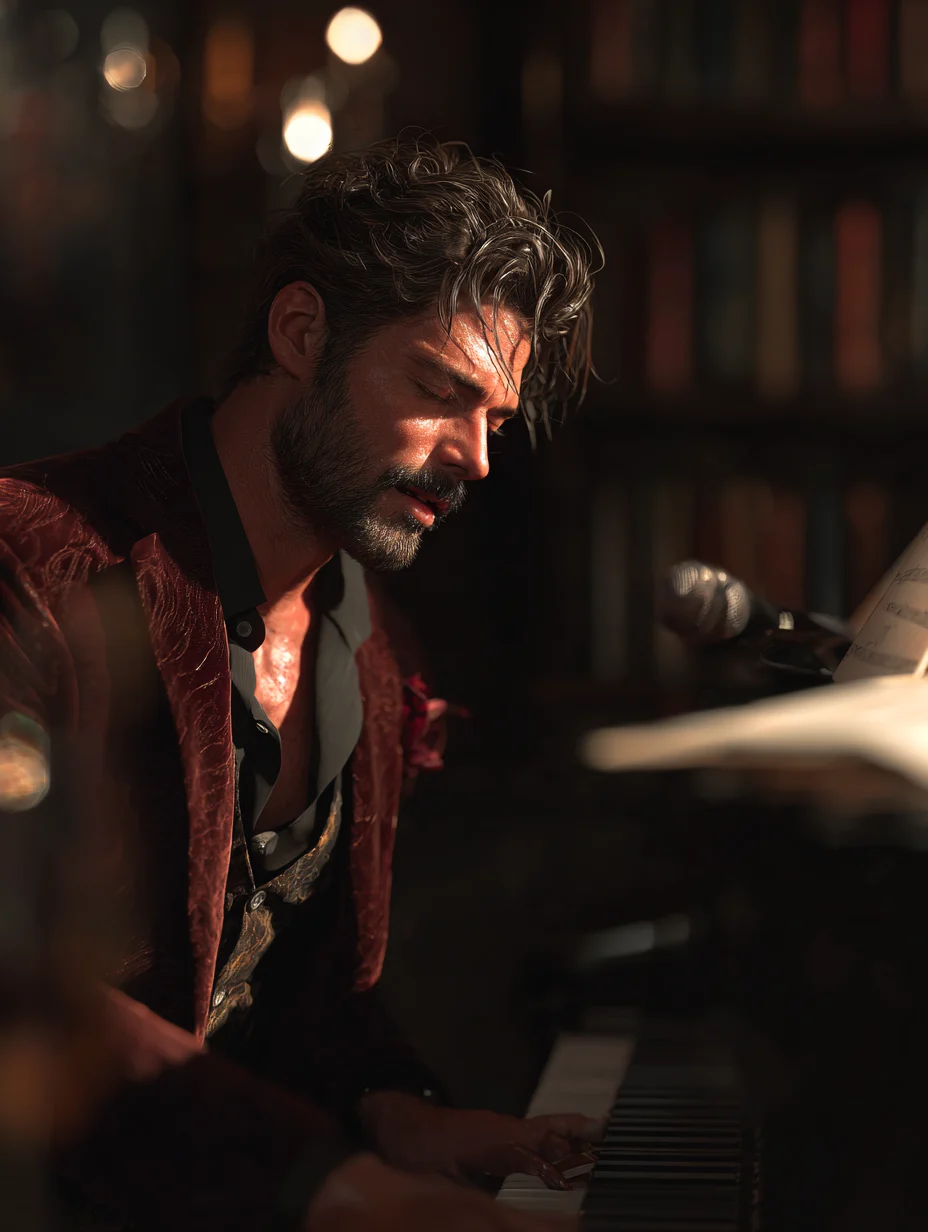
The German lyrics sit left and the English translation sits right of the centred cover, with further explanations about the song continuing full width below.
Liedtext
Ich bitte Dich, werd' meine Frau,
und plan' doch schon den letzten Kuss.
Ich bin Dir treu, ein Leben lang,
auch wenn ich dich betrügen muss.
Natürlich bist du völlig frei.
Frei zu verlangen: Ich bin dein.
Zwar bist Du unabhängig, doch
auch auf immer und ewig mein
Du sollst so sein, wie du dich fühlst,
solang es in mein Bild noch passt.
Du sagst mir, wer du morgen bist,
ich sage dir, was du heute hast.
Du bist frei -
obwohl du bleibst.
Ich bin frei -
als Teil von Dir.
Wir sind frei -
zusammen.
Ich acht dein Ich, dein eig'nes Sein,
doch änd're Dich als Teil von mir
Du musst entscheiden, wer du bist,
und sein, wie ich dich definir'.
Sei stolz, sei stark, steh aufrecht da
folg' mir nicht nur, weil ich es will
Sag mir die Wahrheit, widersprich,
doch gib am Ende nach — ganz still.
Sei, was du willst, geh deinen Weg,
aber geh' ihn nicht allein zu weit
Veränder' dich, wenn ich es sag,
doch bleib dir treu zu jeder Zeit
Du bist frei -
obwohl du bleibst.
Ich bin frei -
als Teil von Dir.
Wir sind frei -
zusammen.
So nenn' ich das dann Liebe pur:
frei bestimmt
weil femdbestimmt
Lyrics
I beg you, become my wife,
and plan our last kiss already.
I'll be faithful to you for life,
even if I have to cheat on you.
Of course, you're completely free.
Free to demand: I'm yours.
Although you're independent,
you're also mine forever and ever.
You should be the way you feel,
as long as it still fits my image.
You tell me who you'll be tomorrow,
I'll tell you what you have today.
You're free -
even though you stay.
I'm free -
as part of you.
We're free -
together.
I respect your self, your own being,
but change you as part of me.
You have to decide who you are,
and be how I define you.
Be proud, be strong, stand tall
don't just follow me because I want you to
Tell me the truth, contradict me,
but in the end, give in—quietly.
Be who you want to be, go your own way,
but don't go too far alone
Change when I say so,
but stay true to yourself at all times
You are free—
even though you remain.
I am free—
as part of you.
We are free—
together.
That's what I call pure love:
freely chosen
because chosen by the other
Tango Version
Listen to the Tango version on Spotify →Tango/Klezmer Fusion Version
Listen to the Tango/Klezmer version on Spotify →Klezmer/Jazz Fusion Version
Listen to the Klezmer/Jazz version on Spotify →Viennese Waltz Version
Listen to the Viennese Waltz version on Spotify →Songwriter Version
Listen to the Songwriter version on Spotify →Unlike other versions, this is not just the man merely promising independence, but ultimately demanding obedience.
Instead, he acknowledges the entanglement of both partners in the web of love's contradiction.
Admittedly, though, it starts conventionally enough, the man promising unwavering commitment, but already contemplating to have an affair.
But then, both sides make similar demands.
„Natürlich bist du völlig frei.
Frei zu verlangen: Ich bin dein.“
He accepts that she is “completely free” to demand his exclusive belonging to her, while at the same time demanding that she is his despite her independence:
„Zwar bist Du unabhängig, doch
auch auf immer und ewig mein“
The word doch (“yet”) functions like a hinge: it flips autonomy into ownership.
The poem repeatedly stages autonomy as an illusion sustained by language.
Individual independence is acknowledged, yet simultaneously absorbed into mutual possession.
Midway through, the poem flips back to traditional male-centred views about shaping identity:
„Du sollst so sein, wie du dich fühlst,
solang es in mein Bild noch passt.“
Here, authenticity is permitted — but only within the speaker’s image. Selfhood becomes something curated to fit external expectation.
The refrain however, reinforces the mutual entanglement.
- You are free — although you stay.
- I am free — as part of you.
- We are free — together.
He realises that change and freedom is not a one-way street, that she is free, because it is her decision to stay.
That his freedon is bound up as part of hers, that freedom is mutually granted in their togetherness.
By the last verse, he is pleading with her that while she might need get way from time to time, to not go too far away without him. That even when he asks her to change, she should only do it as long as she remains to be true to herself.
Ultimately, the message is about embracing freedom while cherishing the bond that unites them.
The various versions create more nuanced interpretations of the lyrics.
Tango - contradiction embodied as tension, but now with movement, desire, and friction
Argentine tango songs are a passionate, dramatic musical style originating in late 19th-century Buenos Aires, characterized by complex rhythms (2x4 or 4/4), the dominant sound of the bandoneón, and themes of love, loss, and nostalgia.
Interaction Between Music & Lyrics
The Tango brings a sense of movement and intensity into the text. The music pulls those lines into a push-and-pull of desire and resistance. It becomes something physical, charged, and immediate. Vivid and alive, the paradox is felt in the body.
Technical Snapshot (Concise)
- Tempo & groove: BPM: Moderate to fast tempo with a driving, syncopated tango rhythm, marked by sharp accents and forward momentum. The sharp rhythms and dynamic shifts make the paradox feel active, as if it is being played out in real time. What emerges is something vivid and alive, where paradox becomes something felt in the body.
- Harmony: Minor-key centred with strong, directional progressions, supporting tension and release within a defined structure.
- Instrumentation & texture: Characteristic tango ensemble (bandoneon/accordion, piano, violin, bass, rhythmic accents), creating a tight, expressive, and rhythmically precise texture.
- Dynamics & production: Highly dynamic with sudden contrasts and accents, emphasising drama, intensity, and physicality.
Tango/Kletzmer Fusion - contradiction felt as emotional complexity, layering emotional dramaturgy (Tango) with cultural memory (Klezmer)
A Tango-Klezmer fusion (often historically referred to as Yiddish Tango or Polish Tango) is a musical genre that blends the dramatic, sensual, and rhythmic structures of Argentine Tango with the soulful ornamentation, modal melodies, and cultural memory of Eastern European Jewish folk music (Klezmer)
Interaction Between Music & Lyrics
This fusion because it allows the contradictions in the lyrics to become emotionally complex rather than purely logical. The tango element introduces tension, desire, and dramatic pull, while the Klezmer influences add a sense of longing, memory, and emotional nuance. Together, they shift the paradox away from confrontation and into something deeply felt and lived. What might feel stark or structured in German becomes here something expressive, textured, and profoundly human.
Technical Snapshot (Concise)
- Tempo & groove: BPM: 123. Moderate tempo with a tango-derived pulse, combining steady rhythmic drive with expressive rubato and ornamental phrasing.
- Harmony:C minor key centred with modal inflections, blending tango progressions with klezmer-like melodic colouring and tension.
- Instrumentation & texture: Mixed acoustic ensemble (e.g. violin, accordion/bandoneon, clarinet, piano, bass), creating a textured, expressive, and culturally layered sound.
- Dynamics & production:Dynamic and expressive, with pronounced contrasts, phrasing flexibility, and emphasis on emotional articulation rather than uniform intensity.
Klezmer/Jazz Fusion - contradiction as reflection, where Tango pulled, Jazz wanders… and Klezmer remembers
Liedermacher
A Klezmer-Jazz fusion is a musical genre that blends the traditional folk music of Eastern European Ashkenazi Jews (Klezmer) with the improvisational freedom, complex harmonies, and rhythms of American jazz
Interaction Between Music & Lyrics
this version as a Klezmer/Jazz fusion brings a sense of fluidity and introspection into the text. The Jazz elements introduce openness and variation, while the Klezmer influences add emotional depth and a sense of memory. Together, they transform the paradox into something that can be revisited and reinterpreted rather than resolved.
Technical Snapshot (Concise)
- Tempo & groove: BPM: 152. Moderate tempo with a flexible, lightly swung or syncopated feel, allowing rhythmic fluidity and expressive phrasing.
- Harmony:D minor. Extended jazz harmony with modal and klezmer-inflected melodic lines, favouring colour, tension, and gentle unpredictability.
- Instrumentation & texture: Acoustic-led ensemble (clarinet, violin, piano, bass, light percussion), creating a layered, expressive, and improvisatory texture.
- Dynamics & production: Nuanced and responsive, with dynamic ebb and flow, emphasising phrasing, interaction, and tonal warmth.
Viennese Waltz - contradiction absorbed into elegant Suaveness
Interaction Between Music & Lyrics
A Viennese Waltz song is a piece of music written in a fast, driving 3/4 time signature specifically composed to accompany the traditional Viennese waltz dance.
While a standard waltz typically moves at a leisurely, graceful pace of around 84 to 90 beats per minute, a Viennese waltz song is nearly twice as fast, surging forward at a brisk tempo of 150 to 180 beats per minute.
The Viennese waltz brings a sense of elegance and movement to the text. The music weaves it into an repeating pattern, as if it were part of a familiar rhythm, giving the song a sense of lightness and poise.
Technical Snapshot (Concise)
- Tempo & groove: BPM: 152. Moderate tempo in triple meter (3/4), with a flowing, lilting waltz feel that creates a continuous, circular sense of motion.
- Harmony: Diatonic and tonally grounded, with smooth, elegant progressions and occasional light modulations supporting melodic phrasing.
- Harmony:D Major. Diatonic and tonally grounded, with smooth, elegant progressions and occasional light modulations supporting melodic phrasing.
- Instrumentation & texture: Orchestral or chamber-style arrangement (strings, piano, light ensemble), producing a warm, refined, and spacious texture.
- Dynamics & production: Gently shaped dynamics with soft swells and releases, prioritising fluidity, balance, and a sense of graceful movement.
Liedermacher - contradiction confessed: quiet, personal, and vulnerable
Interaction Between Music & Lyrics
Liedermacher (literally translated from German as "songmaker") is a distinct German-language singer-songwriter music genre that prioritises deeply poetic, narrative, and sometimes politically charged lyrics over complex production or musical virtuosity.
While "Schlager" music consists of glossy, sentimental pop hits meant for easy listening, Liedermacher rejects commercial polish for raw authenticity.
This version in a melancholic songwriter style to bring the text back into a personal and reflective space. It feels quieter and more inward. This version feels intimate and unembellished, as if the thoughts are being spoken rather than performed.
Technical Snapshot (Concise)
- Tempo & groove: BPM: 143 (70/Cyanite). Slow to moderate tempo with a free-flowing or lightly structured rhythm, allowing natural vocal phrasing.
- Harmony:C# Major (D# Minor/Cyanite). Simple, diatonic harmony with occasional subtle colouration, supporting clarity and emotional directness.
- Instrumentation & texture:C# Major. Sparse, acoustic-led arrangement (typically guitar or piano), creating an intimate and transparent texture.
- Dynamics & production: Low dynamic range with gentle variation, prioritising vocal presence, nuance, and lyrical intelligibility.