
Définition de l’amour - Chanson en duo
French duet chanson - contradiction negotiated by mocking dialogue
Introduction
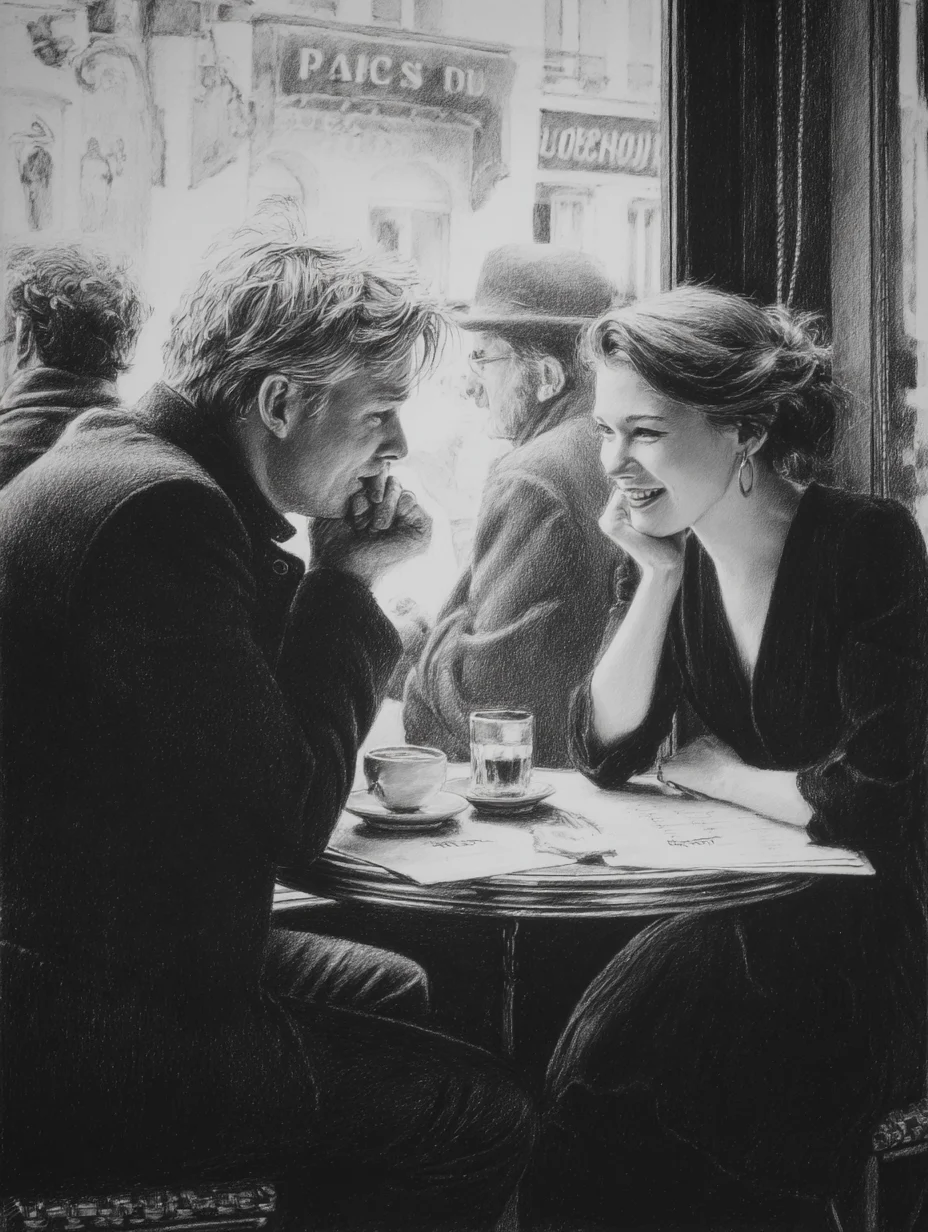
Voici un duo de chanson française typique des années 60, où sa voix est douce, blasée, suffisante, et la sienne légère, limpide, d'une subtile mordant. Le déséquilibre des pouvoirs est toujours présent, mais il vacille désormais.
English Translation
Here’s a 1960s-style French chanson duet, with his voice smooth, blasé, self-justifying, and her voice light, lucid, quietly cutting. The power imbalance is there, but now it wobbles.
Poème français / English Poem
The French lyrics sit left and the English translation sits right of the centred cover, with further explanations about the song continuing full width below.
Paroles de chansons
[Premier couplet - homme]
Je voudrais faire de toi ma femme,
sans trop promettre, naturellement.
Je t’aimerai — disons à ma façon —
et parfois, oui, je mentirai gentiment.
[Deuxième couplet - femme]
Gentiment, vraiment ?
C’est charmant, dis donc.
Tu pars déjà
avant même le refrain.
[Troisième couplet - homme]
Bien sûr, tu es libre, ma chère,
libre d’exiger que je sois à toi.
Jamais dépendante, jamais fière,
et pourtant mienne — enfin, tu vois.
[Quatrième couplet - femme]
Je vois très bien, ne t’en fais pas.
Libre, mais dans ton décor.
Je marche seule, dis-tu ça,
tant que je marche dans ton nord.
[Cinquième couplet - homme]
Je respecte ton être singulier,
ta voix, tes gestes, ton regard.
Je te façonne — rien de cruel —
juste un petit ajustement d’art.
[Sixième couplet - femme]
Un art, oui, très précis.
Tes mains savent ce qu’elles font.
Mais l’argile, parfois, choisit
de durcir hors de ta vision.
[Septième couplet - homme]
Je te veux fière, forte, debout,
obéissante — détail banal.
Dis-moi quand j’ai tort, surtout,
puis cède… ce sera plus normal.
[Huitième couplet - femme]
Je te dirai quand tu as tort,
je le ferai très poliment.
Et si je cède, mon cher trésor,
ce ne sera pas éternellement.
[Neuvième couplet - tous deux, doux, doucement]
C’est ça, l’amour — dit-on souvent —
un doux accord, un léger effort.
Tu dis toujours, je dis peut-être,
et la chanson
continue encore.
Lyrics
[Verse 1 - man]
I would like to make you my wife,
without making too many promises, of course.
I will love you—let's say in my own way—
and sometimes, yes, I will tell a gentle lie.
[Verse 2 - woman]
Gently, really?
That's charming, isn't it?
You're already leaving
before the chorus even starts.
[Verse 3 - man]
Of course, you're free, my dear,
free to demand that I be yours.
Never dependent, never proud,
and yet mine—well, you see.
[Verse 4 - woman]
I see perfectly well, don't worry.
Free, but within your world.
I walk alone, you say,
as long as I walk in your north.
[Verse 5 - man]
I respect your unique being,
your voice, your gestures, your gaze.
I'm shaping you—nothing cruel—
just a little fine-tuning of art.
[Verse 6 - woman]
An art, yes, very precise.
Your hands know what they're doing.
But the clay, sometimes, chooses
to harden outside your sight.
[Verse 7 - man]
I want you proud, strong, standing tall,
obedient—a trivial detail.
Tell me when I'm wrong, especially,
then give in… it will be more natural.
[Verse 8 - woman]
I will tell you when you're wrong,
I will do so very politely.
And if I give in, my dear treasure,
it won't be forever.
[Verse 9 - man, woman, gentle, softly]
That's love—they often say—
a sweet accord, a gentle effort.
You say forever, I say maybe,
and the song
continues on.
French Duet Version (1(
Listen to the Duet version (1) version on Spotify →French Duet Version (2)
Listen to the Duet version (2) on Spotify →French Duet Version (3)
Listen to the Duet version (3) on Spotify →French duet chanson
The 1960s-style French duet chanson is a romantic, intimate vocal style often featuring melodic interplay between a female and male voice. These songs, often featuring soft vocals, acoustic guitars, and strings, epitomize the nostalgic French Riviera aesthetics.
This version feels like two voices smiling… for very different reasons.
The first version is the original duet, his idea of "setting the route pointing north" and her ironic replies "you might want to form me like clay. Good luck with that, as clay sometimes hardens when you are not watching".
The second version follows broadly the duet outline, with the twist that by the 8th verse, sung by both, it is no longer a male understanding of love set against an mocking female reply, but signalling that both partners hold the same view about the definition of love (though tellingly it is her who points out "You say forever, I say maybe").
This idea oof both sharing the same definition of love is then pushed even further by the third version, which admittedly does not follow the original idea of a dialogue with one verse sung by him, and the second verse being the reply by her, but changes with every line - which may not necessarily work from the point of who says what - but I liked the idea of a couple so in tune with each other that they literally finish each other sentences as an affirmation that they both have the same understanding about the nature of their love.
Interaction Between Music & Lyrics
I chose the duet form because it externalises the contradictions in the lyrics, allowing them to be voiced, echoed, or subtly challenged between two perspectives. Instead of a single speaker holding opposing ideas, the tension is distributed across the interaction, making it feel more dynamic and less internalised. The elegance of the chanson style keeps this exchange from becoming confrontational, maintaining a sense of poise and balance. What might feel paradoxical in isolation becomes here something negotiated, shared, and gently explored.
Technical Snapshot (Concise)
- Tempo & groove: BPM: Varies (90-95). Light to mid-tempo with a gentle, swaying rhythmic feel, supporting conversational phrasing between voices.
- Harmony:Diatonic with subtle jazz inflections, providing a stable and elegant harmonic backdrop for vocal interplay
- Instrumentation & texture: Minimal, acoustic-led arrangement (piano, guitar, light rhythm section), leaving space for two distinct vocal lines to interact.
- Dynamics & production: Intimate and balanced, with careful attention to vocal clarity and interplay rather than dynamic contrast.